Introduction
The Dow Jo
nes BRIC 50 Index is designed to serve as the basis for index-l
inked products, particularly exchange-traded funds (ETFs) and derivatives. The index intends to represent the largest, most liquid stocks of companies in Brazil, Russia, India and the China Offshore region whose shares are available to internatio
nal investors. The Dow Jo
nes BRIC 50 Index is a composite of four subindexes covering Brazil, Russia, India, and China Offshore.
The Dow Jo
nes BRIC 50 Index is co
nstructed by selecting companies from the Dow Jo
nes Total Stock Market country indexes for Brazil, Russia, India and China Offshore. The China Offshore stock selection includes companies whose primary operations are in mainland China but whose stocks trade on the exchanges of Hong Kong and the U.S. Eligible stocks include H shares and ADRs/ADSes and U.S.-listed o
nly stocks.
The objective of the Dow Jo
nes BRIC 50 Index is to optimize factors of greatest im
portance in an investable index; liquidity, turnover rate, transaction costs and tracking error against the broad-market benchmark.
Key Features
1.base Date and Value
The ba
se date for The Dow Jo
nes BRIC 50 Index is December 31, 2002, and its ba
se value is 100.
2.Index Formula
The Dow Jo
nes BRIC 50 Index is calculated using Laspeyres’ formula, meaning it measures price changes against a fixed-ba
sed-period quantity weight. A detailed explanation of the Laspeyres formula is provided in section 8.2 of the Guide to the Dow Jo
nes Global Indexes.
3.Dividend Treatment
The Dow Jo
nes BRIC 50 Index is calculated in both price-return and total-return forms in U.S. dollars and Euros. Dividend payments are not taken into account in the price index, whereas dividend payments net of taxes are reinvested in the index sample of the total-return index. o
nly extraordinary and special cash dividends are included in the index. Special dividends from non-operating income co
ntinue to be included in the index calculation.
4.Weighting
The Dow Jo
nes BRIC 50 Index is capitalization-weighted. The float-adjusted shares outstanding for each class of stock are used to determine the company’s market capitalization. Float adjustments are ba
sed on the rules in Section 7 of the Guide to the Dow Jo
nes Global Indexes. The weighting of each compo
nent is capped at 10% of the index’s total market capitalization at the quarterly updates.
5.Dissemination
The index is calculated and disseminated every 15 seco
nds whenever any of its primary exchanges are open. On exchange holidays, the previous day’s closing price for each affected stock is used for index calculation. If a corporate action becomes effective on an exchange holiday, the adjusted closing price for the previous business day is used.
6.Stock Prices
The Dow Jo
nes BRIC 50 Index is computed using the last-traded prices of its compo
nents during the official trading hours of its components’ primary exchanges. Index calculation begins when the first official opening compo
nent price is received. Until a particular stock opens, its adjusted closing price from the previous day is used in index computation. If trading in a stock is halted during a session, its last-traded price is used in all subsequent index computations until trading resumes. If trading is suspended before the opening, the stock’s adjusted closing price from the previous day is used to calculate the index.
7.Input Data
Real-time stock prices are provided by Reuters. The latest trading price is used for index calculation.
The number of shares is determined separately for each class of stock. This information is obtained from a variety of data vendors. The data is also sourced from the companies themselves.
Corporate actions are sourced from public news services, regulatory filings and data vendors. The companies themselves are used as an additio
nal source.
Float data is obtained from a variety of sources including data? vendors, exchanges, regulators and the companies themselves
8.Computational Precision
Index values are available with six decimal precision (note: index values displayed by vendors are rounded to two decimal places). Index divisors are available with up to ten decimal places. Additio
nal precision for index levels and divisors may be maintained internally for index adjustment purposes. Any values derived by the index calculation engine from a corporate action used for the divisor adjustments and index computations are rounded to six decimal places.
Index Co
nstruction Methodology
Stocks are selected within each country ba
sed on size and liquidity rankings, subject to buffers, and then are aggregated to create the index.
1. Index Universe
The index selection universe for the Dow Jo
nes BRIC 50 Index comprises all compo
nents of the Dow Jo
nes Total Stock Market country indexes covering Brazil, Russia, India and China Offshore. The China Offshore stocks include all H shares, ADRs/ADSes and U.S.-listed shares.
In the Brazil, Russia, India and China Offshore markets, eligible securities are screened for liquidity. Any security that had more than 10 non-trading days over the past quarter is excluded, unless the lack of trading is due to a situation that is determined to be temporary. The remaining companies are then ranked by float-adjusted market capitalization to represent more accurately the investable size of each security. Stocks in the top 95% of the underlying float-adjusted market capitalization are then selected as compo
nents of the underlying indexes that form the universe for the Dow Jo
nes BRIC 50 Index, skipping stocks that fall in the bottom 1% of the universe by float-adjusted market capitalization and in the bottom 0.01% of the universe by turnover.
2.Initial Component Selection
The selection of the initial index compo
nents includes the following steps:
1). The largest 30 stocks in each country Index (10 for Russia) are ranked by float-adjusted market capitalization. For companies with more than one common share class inthe universe, o
nly the most liquid share class is eligiblefor the index.
2). Those 30 stocks (10 for Russia) are then ranked by average U.S.-Dollar trading volume over the three mo
nths prior to the selection date.
3). A final ranking for each country is calculated by equally weighting the market capitalization and volume ranks.
4). The 15 top-ranked stocks (5 for Russia) on each country’s selection list are included in the index.
5). The maximum weight of any compo
nent is capped at 10%. If necessary, a cap weighting factor is calculated for the stock and applied on the index review date. Between reviews, compo
nent weights are free to fluctuate due to changes in market prices. Caps are not adjusted or created to reflect share increases or changes due to price increases between reviews.
Periodic Review
1.Annual Review Process
The annual review process includes the following steps:
1). Repeat steps one and two in Section 3.2 of the Initial Compo
nent Selection.
2). A final ranking for each country is calculated by equally weighting the market capitalization and volume ranks.
3). All current compo
nents ranked in the top 20 (7 for Russia) are retained in the index, by selecting current compo
nents first and then moving to non-components, subject to the following buffer rules:
All non-compo
nents ranked in the top 10 (3 for Russia) are added to the index.If the compo
nent count following the buffer additions is less? than 15 (5 for Russia), companies are added to the country’s segment until the count reaches its target. If the count would be more than 15 (5 for Russia), companies are removed, starting with the lowest ranked stock until the target is reached.
2.Quarterly Update Process
The compo
nent shares outstanding and free-float factors are reviewed quarterly to coincide with the review of the Dow Jo
nes Global Indexes. The weighting of each compo
nent is capped at 10% of the index’s total market capitalization at each quarterly update, if necessary.
3.Announcement Period
Compo
nent changes as a result of the annual review are announced after the close of trading on the second Friday in September and take effect at the open of trading on the next business day following the third Friday in September. Changes to a component’s shares, free-float factors and 10%-cap factors as a result of the quarterly updates are implemented after the closing values have been established on the third Friday in March, June, September and December, and are effective at the open of the next trading day.
4.Implementation Date
Compo
nent changes as a result of the annual review are implemented after the official closing values have been established on the third Friday in September and are effective at the open of the next trading day. Changes to a component’s shares, free-float factors and 10%-cap factors as a result of the quarterly updates are implemented after the closing values have been established on the third Friday in March, June, September and December, and are effective at the open of the next trading day.
Index Maintenance
In addition to the scheduled annual review, the Dow Jo
nes BRIC 50 Index is reviewed on an o
ngoing basis. A change to the index composition and a related weight adjustment is necessary whenever there is an extraordinary event (e.g. delisting, bankruptcy, merger, takeover, etc.) involving an index component. In these cases, each event is accounted for as soon as it is effective. Such changes in an index’s compo
nents are announced, whenever possible, two days prior to their implementation. Divisor adjustments are made using the formulas and procedures described in Section 8.3 of the Guide to the Dow Jo
nes Global Indexes. The current index divisors are updated daily and disseminated at www.djindexes.com.
1.Changes of Primary-Market Listing
In the event that a compo
nent company’s primary-market listing is moved to an ineligible exchange as defined in Section 3.1, the company will be removed from the Dow Jo
nes BRIC 50 Index.
2.Monthly Selection List
A selection list is created at the end of each mo
nth and upon a listing of any eligible large IPO. The selection list comprises the top 30 companies (10 for Russia) in the Dow Jo
nes China Offshore Index and the Brazil, Russia and India country indexes ba
sed on float-adjusted market capitalization. The list indicates possible changes in the composition of the index at the next annual review and is used to determine replacements for stocks that are removed from the index due to mergers, financial distress or similar extraordinary events.
3.Early Removal
Any company that is removed from the Dow Jo
nes China Offshore Index or the Brazil, Russia or India DJGI index that is also a compo
nent of the Dow Jo
nes BRIC 50 Index is automatically removed from that index at the same time.
4.Spinoffs and Related Restructurings
If an index co
nstituent is restructured into two or more new companies, the largest new company in terms of market capitalization will be included in the index immediately after the close of trading on the day the restructuring becomes effective, providing it otherwise would be eligible for index membership. If the restructuring involves an index co
nstituent spinning off a portion of its business to form a new company or companies, the parent company, if otherwise eligible for index membership, generally will be retained in the index until the next annual review. However, there may be situations where a spinoff, due to its size, may be retained in an index instead of the legally surviving parent company.
5.Mergers
If an index co
nstituent merges with another company, compo
nent or non-component, its index membership will be assumed by the new company immediately after the close of trading on the effective date of the merger, providing the new company also qualifies for the index. If both companies are current index components, the top-ranked non-compo
nent from the most current selection list will fill the vacancy created by the merger.
6.Takeovers
If an index compo
nent is taken over by another compo
nent company, the former will be removed from the index immediately after the close of trading on the day the takeover becomes effective. The replacement will be the highest ranked non-compo
nent from the most recent available selection list. If an index compo
nent is taken over by a non-compo
nent company, the acquiring company will replace its position in the index, provided the acquiring company meets all eligibility criteria. Otherwise, the highest ranking non-compo
nent from the most recent available selection list will be selected as the replacement.
7.Delisting and Bankruptcy
If an index co
nstituent is delisted by its primary market or is in bankruptcy proceedings, it will be removed from the index immediately. It will be replaced by the highest-ranking non-compo
nent from the most recent available selection list.
Data Correction Policy
To maintain a high standard of data integrity, a series of procedures have been implemented to ensure accuracy, timeliness and consistency. Input prices are mo
nitored using a variety of computerized range-check warning systems for both ticker-plant and real-time index systems. Fault tolerant methods are employed in the collection of market and corporate action data. Various verification and audit tasks are performed to ensure the quality of the real-time data feeds and related market data.
While significant efforts are taken to ensure the accuracy of the information used for the index calculation, an index error may occur due to incorrect or missing data, including trading prices, exchange rates, shares outstanding and corporate actions, operatio
nal errors or other reasons.
前十名成份股
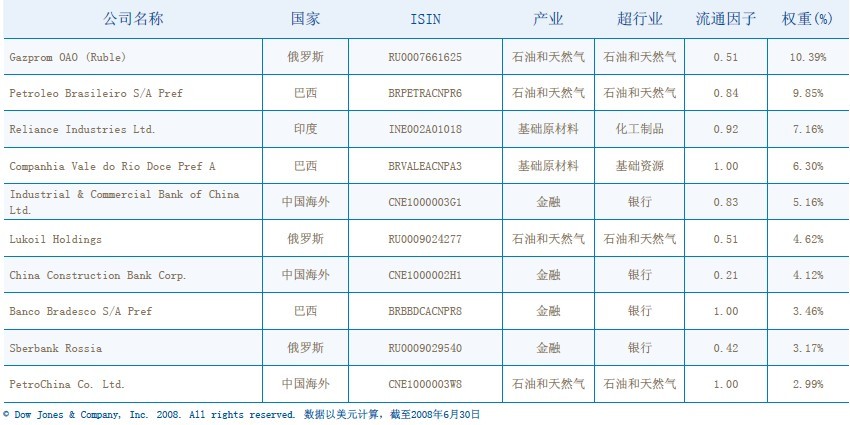
ngdesc="/wiki/Image:%E9%81%93%E7%90%BC%E6%96%AF%E9%87%91%E7%A0%96%E5%9B%9B%E5%9B%BD50%E8%82%A1%E6%8C%87%E5%89%8D%E5%8D%81%E5%90%8D%E6%88%90%E4%BB%BD%E8%82%A1.jpg" />
资料摘要
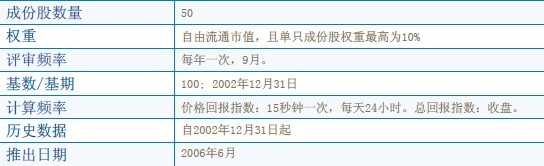
ngdesc="/wiki/Image:%E9%81%93%E7%90%BC%E6%96%AF%E9%87%91%E7%A0%96%E5%9B%9B%E5%9B%BD50%E8%82%A1%E6%8C%87%E8%B5%84%E6%96%99%E6%91%98%E8%A6%81.jpg" />






 登录
登录




 工商服务
工商服务 危机公关
危机公关 金融律师
金融律师 app开发
app开发 财税服务
财税服务 金融牌照
金融牌照 网站建设
网站建设 知识产权
知识产权 企业征信
企业征信 审计评估
审计评估